

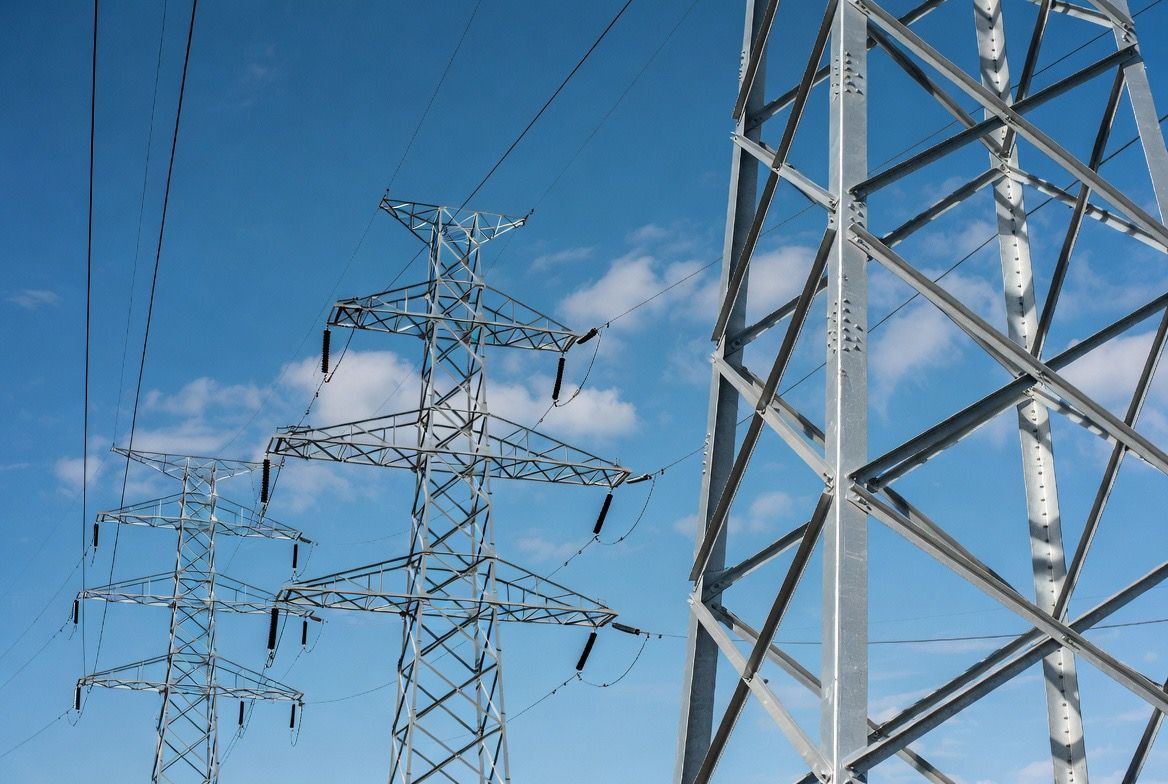
Hot-dip galvanizing of power line towers provides 50–70 years of reliable protection without the need for repainting. Find out why this technology is becoming the standard for the restoration of Ukraine’s energy infrastructure and how it reduces life-cycle costs.
Hot-dip galvanizing of power line towers: reliable protection for Ukraine’s energy infrastructure
The large-scale reconstruction of Ukraine’s energy infrastructure is not just about restoring damaged facilities to working order. It is about creating networks capable of operating for decades under heavy loads, harsh climates, and constant risks. High-voltage power lines, substation gantries, and communication towers are currently being restored under unique conditions where traditional approaches to metal protection no longer meet modern requirements.
The energy sector is one of the most vulnerable industries. Every power line tower is constantly exposed to ultraviolet radiation, extreme temperature fluctuations, industrial emissions, high humidity, and wartime factors—dust, combustion products, and mechanical damage. In this reality, the choice of a corrosion protection method becomes a strategic decision that directly impacts the reliability of the power grid, operating costs, and the speed of the country’s recovery.
Hot-dip galvanizing is a global practice that has proven its effectiveness under the most challenging conditions.
Challenges in Protecting Energy Infrastructure
Steel power line towers and substation components operate in extremely harsh environments. According to the ISO 9223 classification, most of Ukraine falls into corrosion severity categories C3–C4, while coastal, industrial, and eastern regions fall into category C5. Under such conditions, the average corrosion rate of carbon steel is 50–80 μm/year, and in C5 it can exceed 100–150 μm/year.
The war has significantly complicated the situation:
Mechanical damage to the protective layer caused by shock waves and shrapnel;
Chemical contamination of surfaces by combustion products and industrial emissions;
Limited access to facilities due to mine hazards and shelling;
Accelerated atmospheric corrosion due to disruptions in regular maintenance.
Traditional paint coatings exhibit systemic shortcomings under these conditions:
Insufficient thickness and adhesion—even multi-layer systems (epoxy + polyurethane) often fail to provide a reliable barrier in a C4–C5 environment;
Uneven application—hard-to-reach areas (internal pipe cavities, lattice support joints, welds) remain weak points;
Low mechanical resistance—the coating is easily damaged during transportation, installation, and operation;
High maintenance intensity — each repair requires work at height, line shutdowns, specialized equipment, and significant financial resources.
According to maintenance services, transmission towers with conventional protection often require major repairs as early as 7 to 12 years after installation. On a national scale, this results in enormous unproductive costs and a decline in the overall reliability of the power grid.
Hot-dip galvanizing: a metallurgical protection technology
Hot-dip galvanizing is a process in which a prepared steel structure is fully immersed in a bath of molten zinc at a temperature of 448–460 °C. This results in a strong, multi-layered iron-zinc alloy that forms a molecular bond with the steel.
The technology provides dual protection:
Barrier protection—physical insulation of the metal;
Sacrificial (cathodic) protection—zinc protects the steel even if the coating is damaged.
In Ukraine, the process is regulated by DSTU EN ISO 1461:2024. For power line towers, the typical coating thickness is 115–200 μm, providing protection for 50–70+ years. Liquid zinc penetrates all cavities, creating a continuous 360° coating.
Cost-Effectiveness and Life Cycle Cost (LCC)
When selecting a technology for protecting power line towers, it is important to evaluate not the initial cost, but the Life Cycle Cost (LCC)—the total cost of ownership over the entire service life.
Comparative calculation (approximate for a 30–40 m tall tower):
Paint coating:
Initial cost: lower;
Periodic maintenance: every 6–8 years;
Cost per renewal (including lifting equipment, materials, and line de-energization): 35–55% of the initial cost;
Over 50 years: 5–7 painting cycles;
Total LCC: high due to accumulated costs for maintenance, downtime, and logistics.
Hot-dip galvanizing:
Initial cost: 35–60% higher;
Maintenance: minimal (inspection every 8–10 years);
Additional costs over 50 years: mainly only local repairs in case of mechanical damage;
Total LCC: significantly lower after just 8–12 years of operation.
The break-even point for hot-dip galvanizing usually occurs between the 7th and 10th year of operation. After that, the economic benefit becomes significant—according to calculations by the European Galvanizing Associations (EGGA), savings over 40–50 years can reach 40–65% compared to traditional painting.
For government tenders and large infrastructure projects, this approach allows for:
Accurately forecasting the budget for decades to come;
Reducing the risk of cost overruns;
Improving the project’s NPV (Net Present Value).
Real-world experience
In 2024, a common problem arose on one of the high-voltage power lines in central Ukraine: the towers, installed eight years earlier with a traditional paint coating, began to corrode rapidly. The maintenance team documented significant metal damage at the bottom of the structures and at the welded joints.
Following an inspection, it was decided to replace the damaged sections and apply hot-dip galvanizing with a coating thickness of 145–175 μm.
Results of the follow-up inspection after 18 months:
Wear of the zinc layer was only 5–8 μm;
No signs of corrosion of the base metal were detected;
Internal cavities and complex assemblies are fully protected;
Maintenance cost savings for the site during this period exceeded 45% compared to the previous approach.
According to calculations, the use of hot-dip galvanizing increased the projected service life of the supports by more than four times. This example clearly demonstrates that the transition to modern protection technologies pays off even in the medium term.
Strategic importance for Ukraine's energy security
The restoration of energy infrastructure is not merely a technical task, but a matter of national security and the country’s resilience. The reliable operation of power transmission lines directly affects:
The stability of the power grid as a whole;
The ability to integrate renewable energy sources (solar and wind power plants);
The uninterrupted operation of critical infrastructure (hospitals, water utilities, military facilities, data centers);
Regional economic activity and investment attraction.
Hot-dip galvanizing allows for the creation of structures that retain their protective properties even in the event of localized damage. This is particularly critical in environments with military risks, where access for regular maintenance may be limited or dangerous.
In addition, the use of this technology is of significant strategic importance for:
European integration — projects implemented in accordance with DSTU EN ISO 1461:2024 are significantly better aligned with the requirements of European donors and banks (EBRD, NEFCO, USAID, World Bank);
Reducing dependence on imports — durable poles reduce the need for constant network renewal;
Environmental sustainability — zinc is a fully recyclable material, and modern hot-dip galvanizing lines have a low carbon footprint;
Long-term planning — the government and major operators can accurately forecast costs 40–50 years in advance.
In conclusion, the transition to hot-dip galvanizing of power line poles is an investment not only in metal, but in the country’s energy independence and sustainability for decades to come.
FAQ
What is the actual service life of hot-dip galvanized power line towers?
In most regions of Ukraine, it is 50–70 years or more without the need for re-coating.
Is hot-dip galvanizing cost-effective for government projects?
Yes. Despite the higher initial cost, it is significantly more cost-effective over the product’s lifecycle.
Can already installed poles be galvanized?
Typically, the technology is applied during the manufacturing stage or during the reconstruction of sections.
Does the technology comply with European standards?
Yes, it fully complies with DSTU EN ISO 1461:2024.
By Yaroslav Dombrovsky. Source of information: budport.com.ua