

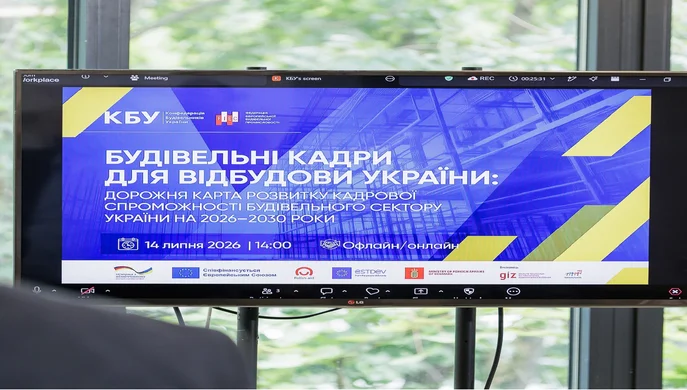
On July 14, 2026, a roundtable discussion “Construction Personnel for the Reconstruction of Ukraine: Roadmap for the Development of Human Resources Capacity in the Construction Sector of Ukraine for 2026–2030” was held. The event was organized by the Confederation of Builders of Ukraine with the support of the multi-donor initiative Skills4Recovery.
The event brought together representatives of state authorities, construction companies, industry associations, educational institutions, the State Employment Center, the National Qualifications Agency, trade unions, public and international organizations. The participants discussed ways to overcome the shortage of qualified workers in construction, update the system of their training and strengthen cooperation between business, education and the state.
The event was moderated by the General Director of the Confederation of Builders of Ukraine Oleksandr Chervak. Opening the round table, he emphasized that the issue of human resources today is one of the key factors in the successful reconstruction of Ukraine.
“The construction industry traditionally has one of the largest multiplier effects for the country's economy. At the same time, no investments, technologies or projects will be implemented without people who can professionally and safely perform work. That is why the development of human resources should become one of the priorities of state policy and business,” said Oleksandr Chervak.
Iryna Shumik, Director General of the Directorate of Vocational Education of the Ministry of Education and Science of Ukraine, shared information on the transformation of the vocational education system and new approaches to licensing and certification of qualifications, emphasizing the need to increase the flexibility of the education system and its adaptation to the needs of the economy. According to her, important components of such changes should be independent certification of qualifications, simplification of access to educational programs and active involvement of business in training personnel.
An important topic of discussion was the forecasting of future labor market needs and the formation of effective mechanisms for training specialists for the reconstruction of the country. Bohdan Matviychuk, Director of the Employment Department of the Ministry of Economy, Environment and Agriculture of Ukraine, emphasized the need for a systemic approach to human capital development, noting that over the next decade the construction industry will become one of the largest employers in Ukraine. According to forecasts, if today the sector employs about 520 thousand people, then by 2036 the need for workers may increase to 1.2 million. In this regard, the issues of professional training, retraining and involvement in the industry of young people, veterans, internally displaced persons and people with disabilities are becoming particularly relevant.
The topic of staffing in the industry was continued by Inna Vakhovych, Director of the Department of Pricing, Economics and Construction Organization of the Ministry of Community and Territories Development of Ukraine, who focused on the importance of forming a competitive labor market in construction. According to her, in order to attract and retain qualified specialists, the industry must provide competitive and transparent remuneration. That is why the Ministry of Community and Territories Development of Ukraine is working to improve approaches to pricing and take into account the real level of wages when forming the cost of construction.
Among the key issues of the event was also a discussion of the development of the system of professional qualifications and its adaptation to the current needs of the labor market. The Head of the National Qualifications Agency Yuriy Balanyuk noted the active participation of the construction industry in this process, noting that today it is one of the leaders in the formation of a modern system of qualifications. According to him, 14 professional standards in the construction sector have already been developed and work is underway on new documents designed to ensure that the training system meets the real needs of employers.
The participants paid special attention to the situation on the labor market. Liliya Grabovska, Deputy Director of the Department of International Cooperation and Partnership in Education of the State Employment Center of Ukraine, drew attention to the significant imbalance between the number of vacancies in the construction industry and the availability of specialists with appropriate education and experience. She emphasized the need to introduce new motivational tools, vocational training programs and mechanisms for attracting people to construction professions, which should become one of the key elements of ensuring the human resource capacity of the sector.
The head of the Skills4Recovery component of the multi-donor initiative, Oleksiy Oleksiuk, emphasized the shortage of specialists with practical skills in working with modern materials, technologies and equipment, as well as with proper knowledge of safety requirements. Because of this, companies are often forced to additionally train new employees after they have been hired.
“Even with funding and ready-made projects, reconstruction can slow down if there are not enough people who can perform the work qualitatively and safely. Therefore, training should be based on the real demand of employers, provide for more practice and give a person a clear path to confirmation of qualifications and employment,” Oleksiy Oleksiuk noted.
During the event, the results of the first comprehensive industry research on the personnel needs of the construction sector were presented, which was presented by the Head of the B2B and Strategic Research Department of CBR Company Tetyana Sytnyk.
The research showed that the most demanded professions in the industry remain welders, bricklayers, concrete workers, electricians, plumbers and specialists in internal engineering networks.
“The problem of personnel shortage in construction is not only military, but also structural in nature. Business is ready to invest in training employees, but expects more flexible, practical and short-term training programs adapted to modern technologies and real production needs,” emphasized Tetyana Sytnyk.
The concept of the Roadmap for the Development of Human Resources Capacity in the Construction Sector of Ukraine for 2026–2030 was presented by the Head of the Committee of the KBU on Legislative and Regulatory Activities, Partner of the law firm Altelaw&Sempra, Member of the Board of Directors, KBU Olga Sydorchuk.
The document provides for the formation of mechanisms for the industry's self-sufficiency in personnel, the development of dual education, the improvement of state procurement in accordance with market needs, the updating of professional standards and educational programs, the development of training and assessment infrastructure, as well as the implementation of the concept of a builder's ID card.
"The roadmap offers a systematic approach to the development of the industry's human resources potential - from forecasting market needs and updating educational programs to creating financial incentives for employers who invest in employee training and the development of dual education," said Olga Sydorchuk.
Following the strategic discussion, participants provided suggestions for the draft Roadmap, which will be taken into account during its finalization.
The Skills4Recovery approach assumes that the result of training should not be just completed courses, but confirmed qualifications and real employment. Therefore, the Roadmap proposes to track how many participants have completed their training, confirmed their qualifications, found work in their profession and remained working in the industry. The programs plan to involve youth and adults, veterans, internally displaced persons, women, self-employed workers and people changing professions.
Dual education is not considered a universal solution, but as one of the possible formats - provided that the employer has a production base, mentors and is ready to provide meaningful practical training.
The next stage will be the public presentation of the Roadmap for the Development of Human Resources Capacity in the Construction Sector of Ukraine for 2026–2030, which will take place on August 5, 2026.
For reference:
Skills4Recovery is co-financed by the European Union, Germany, Poland, Estonia and Denmark and implemented by Deutsche Gesellschaft für Internationale Zusammenarbeit (GIZ) GmbH and Solidarity Fund PL in partnership with Ukrainian institutions.
Source: propertytimes.com.ua