

The demand for concrete plants in Ukraine is gradually growing — it is formed not only by civil construction, but also by energy infrastructure protection projects, shelter construction, and preparation for large-scale reconstruction.
The founder of 4BUILD, Yevgeny Bryzhakhin, told Prof Build about the trends in the concrete equipment market, new technological requirements, and expectations of the industry in the coming years.
In previous years, the market for concrete plants and concrete equipment in Ukraine has demonstrated a gradual increase in demand, which is formed not only by civil construction, but also by projects related to the safety and stability of the infrastructure.
A significant increase in demand is provided by the strengthening of critical energy infrastructure — in particular, the construction of monolithic protective sarcophagi for substations, as well as the construction of enclosing structures from special-purpose concrete blocks with integrated plates for connection and quick installation.
Such projects require a stable supply of concrete directly to the site, which stimulates investments in their own concrete units.
A separate significant impetus to the market was given by the mass construction of shelters for schools, kindergartens and public facilities, where the speed of implementation, repeatability of structures and quality control of concrete mixtures are key.
Additionally, it should be noted the growth of construction activity in the western regions of Ukraine, where demand is formed both at the expense of the private sector and defense and infrastructure facilities.
Why are mobile and modular concrete plants in greater demand than large stationary ones today.
In general, demand remains pragmatic and project-oriented. However, it has a clear growth trend and is already laying the foundation for larger-scale market development in the post-war reconstruction period.
Currently, the concrete plant market in Ukraine is conditionally divided approximately in a 50/50 ratio between mobile and stationary solutions, which is directly related to the format and duration of construction projects.
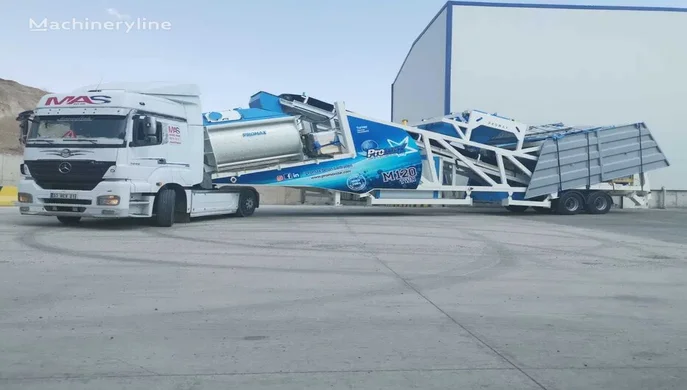
For a quick start of construction, temporary or small production sites, customers most often choose mobile concrete plants with a capacity of 20–40 m³/h. Typical customers of this segment are road construction companies, contractors of infrastructure and defense facilities, communities and enterprises implementing projects with limited deadlines. The key advantages of such plants are ease of transportation, short installation times, lower investment cost and flexibility in use.
It is important that, if necessary, a mobile concrete plant can be upgraded to a stationary one by retrofitting with additional bunkers, stationary silos, automation systems and increasing the level of energy efficiency, which allows customers to gradually increase production without completely replacing equipment.
For permanent construction and long-term projects - in particular, ready-mix concrete manufacturers, reinforced concrete plants, developers and large infrastructure contractors - stationary concrete plants with a capacity of 60–140 m³/h are mainly used.
One of the basic market requirements has become a high-precision dosing system for inert materials, cement, water and chemical additives, which allows to ensure the repeatability of recipes and compliance with the requirements of current building codes and quality standards.
Among the most popular solutions, it is also worth noting the option of backup power supply in the form of a diesel or gas generator, which allows the concrete plant to operate in conditions of unstable power supply without stopping the production cycle.
The demand for fully automated concrete plants, where personnel participation is minimized, has increased significantly.
A separate category of requests is formed by manufacturers of reinforced concrete products, for whom automated moisture control of inert materials and concrete mix is critically important, since it directly affects the strength, stability of characteristics and quality of finished products.
At the same time, not only the technical component of the equipment, but also the quality of service and the availability of spare parts are becoming increasingly important for customers. Customers are increasingly willing to invest more at the procurement stage, but to be sure that possible breakdowns will not lead to long downtimes and loss of production time.
The demand for automation, digital dosing systems, monitoring and online quality control in 2024–2025 has increased significantly, and for many customers it is no longer an advantage, but a basic requirement for a concrete plant.
A separate illustrative example is projects using alternative energy sources. Thus, in 2024, one of the customers of “4BUILD” in the city of Nikopol implemented a concrete plant that is 100% powered by solar panels. This became a practical example of a real transition to energy-independent production even in difficult conditions.
In parallel with power supply solutions, modern technologies allow reducing the installed capacity of equipment without loss of productivity, and in some cases even increasing its efficiency.
In particular, in the 4BUILD belt conveyors, energy consumption is reduced by approximately 20% compared to similar solutions.
As a result, energy efficiency today is formed not by a single solution, but by a combination of correct generation, electronics protection and optimized mechanics, which allows concrete plants to operate stably even in the most difficult conditions.
In the previous two years, the availability of components and spare parts for concrete equipment generally remained manageable, despite difficult logistical conditions and the dependence of individual components on imports.
The availability of critical components in the manufacturer's warehouse plays a key role in the stability of equipment operation. In particular, we constantly maintain a stock of the main consumables and key components - conveyor belts, electric motors, mixer armor and blades, pneumatic components, electrical and automation systems.
In general, the market has adapted to the new realities, and now the decisive factor for the customer is not only the price of the equipment, but also the confidence in fast service and availability of spare parts throughout the entire life cycle of the concrete plant.
High-precision dosing systems are now perceived as a mandatory standard, not an additional option. This is due to both the requirements for concrete quality and the need to comply with modern building codes and reduce the impact of the human factor.
Increasingly, customers are installing additional bunkers for inert materials, cement and additives in their projects in order to have greater flexibility in formulations and the ability to quickly adapt production to different types of concrete.
It is worth noting the growing demand for winter options and all-season solutions - insulation of units, heating of inert materials, water and pipelines. Customers strive to ensure stable operation of the equipment regardless of the season and weather conditions.
That is, the modern client chooses not just a concrete plant, but a flexible technological platform that allows you to work today and scale tomorrow without a complete replacement of equipment.
In recent years, the demand for equipment for the production of special concretes (RCC, road concrete, high-strength mixtures) has increased significantly. This is directly related to the change in the construction structure in Ukraine and the growth of the share of infrastructure, road and specialized facilities.
Increasingly, concrete manufacturers are focusing on universal concrete plants that are able to work not only with classic commercial mixtures, but also effectively complete special-purpose tasks without loss of quality and productivity.
At the same time, manufacturers often overestimate the versatility of equipment and believe that one concrete plant is able to effectively complete too wide a range of tasks - from small batches to intensive serial production of special concretes. Without the right configuration selection, this leads to a decrease in efficiency or loss of quality. Another typical mistake is incorrect calculation of the project's economics and business model.
Quite common is the situation when customers deliberately underestimate the required equipment performance, and subsequently operate the plant at the limit modes. Constant operation at maximum load reduces the equipment resource and increases the risk of emergency shutdowns.
In general, the main mistake is that the concrete plant is perceived as a separate product, and not as a complex production system that must be selected for real operating conditions, current tasks and business development prospects.
Regarding the assessment of the prospects of the concrete plant market after the start of large-scale reconstruction of Ukraine, Yevgeny Bryzhakhin believes that
in the first two years after the start of large-scale reconstruction, the demand for concrete plants in Ukraine will grow gradually, but very dynamically, with a clear link to state and international funding programs.
The first year of reconstruction is likely to be characterized by high demand for mobile and compact concrete plants, which allow for rapid deployment of production directly at the facilities - in particular for the restoration of critical infrastructure, roads, bridges, shelters and social facilities.
In the second year of reconstruction, a shift in emphasis is expected towards stationary concrete plants of medium and high productivity, which are oriented towards long-term operation, serial construction and stable volumes of concrete production.
It should be noted that demand will be formed not only quantitatively, but also qualitatively. Customers will focus on modern, automated solutions with high energy efficiency, stable product quality and reliable service support.
Source of information: profbuild.in.ua