

Ukrainian business has proven that it is capable of building sustainable systems.
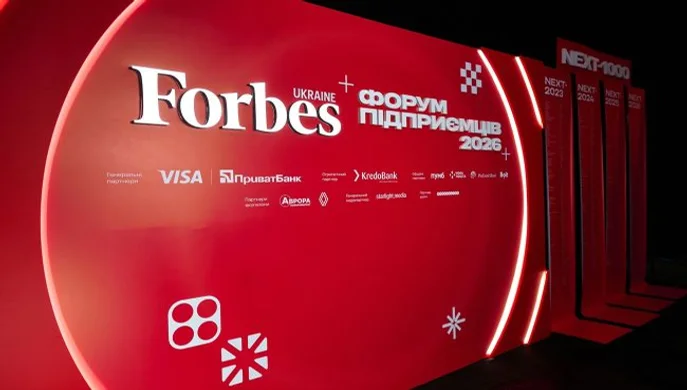
On June 25–26, Forbes Ukraine gathered over 700 entrepreneurs, investors and CEOs in Kyiv at the Entrepreneurs Forum 2026 under the slogan “Business Generator: Recharge Among Your Own”. The two-day event was dedicated to companies’ exit from operational chaos, automation, AI integration and scaling strategies. A separate landmark event of the Forum was the announcement of the new NEXT250 list – a list of the most promising small and medium-sized businesses in Ukraine.
Market leaders shared their insights on stage at the event. Below are the key ones.
Trend 1. Transformation of thinking: from manual control to systemic business.
The speakers of the forum agreed that the main barrier to a company’s growth is often its founder himself, who tries to control every process on his own.
"Never fall in love with your business. You can fall in love with a country, a wife, a daughter - you have to respect business," said Vasyl Khmelnytsky, founder of the UNIT.City innovation park and the Bila Tserkva industrial park.
According to Khmelnytsky, Ukrainian entrepreneurs tend to overestimate their own business and strive to maintain full control until the end of their lives, while the mature approach is to build, sell a stake, reinvest and move on, rather than identifying their own identity with the company.
The investor called production, logistics and residential real estate around Kyiv the areas with the greatest potential, while coffee shops, beauty salons and fitness clubs - seemingly profitable, but in fact unprofitable niches.
"First, understand where the goal you want to reach is, and then honestly answer the question - who is the bottleneck. Often you yourself can be this bottleneck," shared Rostyslav Vovk, co-founder of Kormotech.
The speaker shared a case of a company that completely changed its structure and strategy when the old system began to restrain business growth, and Vovk openly admits that at some point he was the bottleneck.
"I want this company to work for many, many more years, and my great-grandchildren would say - damn, we had a cool grandpa", said Oleksandr Berezhansky, founder of Berta Group (revenue 18 billion UAH).
Berezhansky emphasized the importance of scaling around the client and the need to trust the team, completely abandoning the need to control everything yourself.
Trend 2. Customer experience, marketplaces and creating "love brands".
Special attention at the forum was paid to building long-term user trust and working in oversaturated markets.
"Every order you place is a vote for the future", noted Iryna Chechotkina, co-founder and co-CEO of Rozetka.
Despite 16 destroyed stores, the company's online sales grew by 10% in 2024. Chechotkina emphasized that Ukrainian e-commerce has huge room for growth, and marketplaces are becoming the winners of global competition.
"You can't launch one cool advertising campaign, bake one delicious bread - and that's it. Tomorrow you need to do even better", says Valeria Tolochyna, CMO of Megogo (in conversation with Leila Tuvakliyeva, Bakehouse, and Tetyana Parfileva, Cher'17).
The speakers noted that the status of a favorite brand is formed by daily work on quality, and the main mistake is believing in a "magic pill" instead of a systematic routine.
"A developer is a person who puts himself in the user's shoes. If you can't do it, don't do it", advises Igor Nikonov, founder of KAN Development.
In developing spaces, KAN is guided by the rule: imagine yourself as the most evil, most demanding resident. The company sells not square meters, but a way of life (Comfort Town, Fayna Town, Respublika), where 85% of people do not leave even during the war.
"I don't compete, I cooperate", said Liliya Lytkovska, founder of the LITKOVSKA brand.
Instead of fighting for attention in the fashion market, the designer puts all her energy into the product. Its own identity, rather than market adaptation, opened the brand's doors to retailers in the USA, Paris, and Japan.
Trend 3. Artificial Intelligence, Reputation, and New Management Models.
Modern business is impossible without technological transformation and a transparent reputation, especially in the conditions of a full-scale war.
"When you get a result from AI that you are not satisfied with, it is not because the AI is stupid, but because you did not provide enough context", emphasized Mykhailo Rogalsky, co-owner of Fintech IT-Group.
Rogalsky completely replaced the development team of his hobby project Walkable with AI, which radically accelerated the execution of processes. He admits: any product can now be copied in months, so the main barrier for competitors remains brand, trust, and scale.
"Paying taxes today is the duty of every citizen", emphasized Volodymyr Tsoi, co-founder of MTI Group.
Transparency and reputation have helped the company overcome all crises without stopping projects, and in negotiations MTI always chooses long-term partnership over instant profit.
The two-day Entrepreneurs Forum clearly proved that despite all the challenges, Ukrainian business has finally outgrown the stage of simple survival and is confidently building sustainable systemic companies.
Sources of information: rbc.ua, mind.ua.